You can find more interactive games and activities like this one on BBC Schools website.
Thursday, 10 December 2015
Revising animals and food chains for Bilingual Science
Dear year 6 kids, here you are an interactive game to help you learn about animals and food chains. Enjoy!
You can find more interactive games and activities like this one on BBC Schools website.
You can find more interactive games and activities like this one on BBC Schools website.

Adolescentes y móvil: Guía para padres desesperados
En el blog de Uveni he encontrado este interesante artículo a modo de guía para ayudar a padres con hijos adolescentes en la gestión del uso del teléfono móvil. Si bien nuestros niños de 5º y 6º aún no son adolescentes, no viene nada mal tenerlo en cuenta pues podemos aplicar muchos de estos consejos a su edad actual. El blog contiene otros artículos muy útiles para orientarnos en nuestra labor educativa así que aprovecho para recomendar su lectura regular.

Puedes leer el artículo completo aquí.
Saturday, 5 December 2015
Cómo organizar nuestro lugar de estudio en casa
A la hora de estudiar o hacer tus deberes en casa, existen unos pequeños consejos que te pueden ayudar mucho. Observa la siguiente infografía:
 | ||||
Puedes descargar esta imagen en PDF para poder imprimirla en este enlace.
También puedes ampliar la información leyendo el artículo donde está publicada la infografía anterior en su web original: Cinco claves básicas para organizar el lugar de estudio
Monday, 23 November 2015
Revising clothes (constructor)
This unit we are learning about some accessories vocabulary in year 6: belt, earrings, boots, rucksack, etc. But can you remember the name of clothes?
There are a lot of different activities in Constructor website. You can revise English, Maths, Science, Spanish...
Sunday, 22 November 2015
Stop Motion in Arts class (Year 6)
What is "stop motion"?
According to Wikipedia, Stop motion is an animation technique that physically manipulates an object that appears to move on its own. The object is moved in small increments between individually photographed frames, creating the illusion of movement when the series of frames is played as a continuous sequence.
Shaun the Sheep Movie, Frankenweenie, Wallace & Gromit: The Curse of the Were-Rabbit or Chicken Run, are some examples of modern films using stop motion technique. We take pictures and we move the objects on the scene. Finally we play the pictures one after another and we get the feeling that the objects are moving. Here you are a classic movie filmed using the stop motion technique: The Lost World (1925)
What do we need?
We have used our tablets or smartphones cameras and software. For Android devices we used Stop Motion Studio. Thanks to this app you can take pictures and create the video. With this free version we cannot add music so we needed another app like VideoShow.


Extra material for our films have been: toys, plasticine, card, paper... almost any material we thought that could be very useful for our film making. We created characters and a scenary!
Steps we followed
In order to create our project we followed these steps:
1. Planning: we divided our class into groups of three or four students.
2. Designing: we agreed on the topic of our video, the characters and the script.
 |
| Writing the script |
 |
| Modelling our characters |
 |
| Modelling our characters with plasticine |
 |
| Creating the backgrounds |
 |
| Time to start taking pictures! |
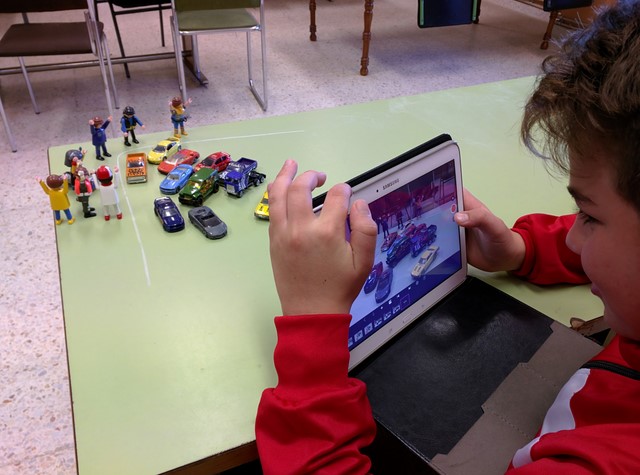 |
| We take picture after picture after picture to create our film |
4. Edition: In this step of our project it is time to edit our video and add some music to it!
5. Promotion: Currently undergoing! We are uploading our films to online servers (YouTube, Vimeo...) sharing it with our classmates via our class blog, school website, etc.
We will soon hold our films premiere in class and analyse what we have learnt in this project, what we have done well and what we need to improve for the future.
Sunday, 15 November 2015
Padres conectados para hijos online
Estimados/as padres y madres, comparto esta interesante infografía que he encontrado en un blog con todos vosotros por los sabios consejos que nos ofrece en nuestro modo de actuar con nuestros niños y niñas en la red. Haciendo clic sobre la imagen podréis verla a mayor tamaño.
 | |
| Fuente: TICs y Formación, blog personal de Alfredo Vela |

Subscribe to:
Posts
(
Atom
)